 |
| Kestrel & at least one chick nesting on cliffs near Findochty - I first spotted the nest a few years back and was really pleased to find it still in use last week - obviously a good spot to raise a family! |
Saturday, 2 June 2012
Kestrels

Someone Else's Child
We first saw you;
spreadeagled,
labelled,
fighting painfully
for breath
in a perspex cot.
Burdened by
the choices,
or lack of choices,
of those who
brought you
into the world -
Someone else’s child.
Though they loved you,
they couldn’t keep you,
and with breaking hearts
allowed us
to give you
what they could not.
Wrapped tightly,
against the pain
that wracked
your tiny frame,
we took you home,
and held you close -
Someone else’s child.
You grew – oh how slowly:
Not for you the easy life
but hard-won -
doubly precious,
celebrated the day;
you crawled, and walked,
and ran, and talked.
So small,
yet full of life
and fierce joy,
infectious as your smile:
We loved you as our own -
Someone else’s child.
But then the day
we knew must come,
when from our arms,
loving hands
claimed you.
And so, we gave you
to them -
the hardest thing
we’ve ever done;
with all the love,
and prayers
our hearts could muster -
Someone else’s child.
Life moves on:
both ours and yours,
But we cannot forget;
a time,
a place,
a smile,
a story;
it doesn’t take a lot
to bring you back -
with our hopes,
and dreams,
and love for you -
Someone else’s child.
Don't Step on the Rope

Reflections on Leadership, Relationships and Teamwork, Walter C. Wright, 2005, Paternoster Press.
Some years ago I was introduced to the writing of Walter Wright (Executive Director of the De Pree Leadership Centre at Fuller Theological Seminary and formerly President of Regent College) through his book ‘Relational Leadership’. There he defined leadership as a relationship of influence; in which one person seeks to influence the vision, values, beliefs, attitudes, behaviours of another. As a Pastor, seeking to lead a church towards its calling in God, it was helpful to understand that the heart of leadership is relationship, rather than position. Wright enabled me to understand that such leadership is rooted in servant-hearted character and measured by influence on those who follow.
Having been blessed by his book on leadership, when I found out that he’d written again on teamwork, I bought the book; but it has sat on my bookshelf for a few years now, patiently waiting to be read. As I began my Sabbatical, it was the first book I picked up.
For over 30 years, Walter Wright has been enjoying the wilderness in the company of the same close-knit team of friends. Together they arrange expeditions; climbing mountains and exploring the backwoods in one another’s company. Becoming increasingly adventurous over the years, they found a need to learn proper mountaineering skills. One of the principal lessons was the need to rope together to safely negotiate vertical climbs, precipitous ridges and treacherous glaciers. In this book Wright uses the metaphor of the climbing rope, and those who have clipped into it, as a defining image of what it means to be team. In his words;
Teams are groups of people who have chosen to tie into a common rope...The rope is the relationship between leader and follow-up...Tying into a rope team is an issue of personal choice and personal risk. Your future is now connected to the strengths and weaknesses, the vision and values, the skills and abilities of another, and others are tied to you.
Teams begin with and are shaped by, a shared vision, which also shapes shared values that hold a team together. Wright points out;
Effective teams are bound together by virtual ropes. It would be well for us to keep those ropes in mind and to know the people to whom we are tied.
In joining a team, “we have abandoned ourselves to the strengths and weaknesses of others”. Each team member contributes their own knowledge, skills, experience, and interests. But together the team has abilities that exceed the capacity of any one of its members. This informs Wright’s definition of a team as;
‘a small group of people working together on a common objective, dependent upon one another’s contribution, knowing each other’s strengths and weaknesses, caring about each other’s growth and development, and holding one another mutually accountable.
Teams depend on trust and mutual respect to hold them together when the purpose of the team takes priority over the agenda of individual members. It’s this basic compatibility, this sense of belonging together, that gives them synergy. Without it, teams are little more than collections of individuals.
Because of this need for trust and respect, the ability of a team to work effectively is directly proportionate to the strength of its relationships. Communication is at the heart of every relationship. Thus the effectiveness or otherwise of team communication, is an issue of success or failure. In this context Wright highlights the importance of listening and of talking. Talking about hopes and dreams, fears and anxieties, what we’re learning and what we want to know. And listening well enough to hold each other accountable to the vision and values we profess.
It is this strongly relational context that enables teams to handle the inevitable conflicts. In Wright’s words;
A strong community cares enough for its members to hold them accountable to their commitments and to confront them when necessary. Confrontation is a sign of caring.
In this context it is helpful to see Wright’s distinction between confrontation and criticism;
Confrontation is holding you accountable for your stated values and commitments because I care about you. Criticism is often holding you accountable to my stated values and expectations because I care about me.
As someone who tends to avoid conflict until last resort, I found it reassuring to be reminded that, ‘All great relationships, the ones that last over time, require productive conflict in order to grow.’ It was helpful to see conflict not as something others impose on me but as something that comes from within, an ‘internal response we have when we encounter something different from what we expect or desire.’ Wright has confronted me (!) with conflict as a natural part of developing relationships that must be faced and dealt with. His wise advice being;
...the sooner we talk about these feelings the sooner we can learn how to resolve them and move forward in the relationships...When conflict is not faced, relationships are damaged and team objectives are clouded.
This book encouraged me to reassess what I contribute to the teams I am part of. In his words, ‘The strength and the weakness of teams is that the actions and attitudes of each individual member impact the effectiveness of the team as a whole.’ As each team member’s contribution affects everyone else, the effectiveness of the team is directly proportional to the quality of each person’s contribution to the shared values and vision of team. This means that each member must take responsibility for the team and continually seek to sharpen their competence and strengthen their contribution towards it.
Team members are each in turn, shaped by their own experience and communities. We are who we are because of the events of our lives and our network of relationships. Thus;
What happens in any community to which we belong affect who we are and the strengths, weaknesses, fears, and confidence we bring to the team...The strengths and weaknesses that make up who we are at any moment, shaped by our own interactions with a network of relationships, govern what we bring to the team.
Which means, ‘what is happening in the larger life of team members can impact their contribution and thus further or limit team success.’ For this reason Wright encourages me to see a significant part of my contribution to the team as learning to care more passionately for fellow team members;
...I need to know what is going on in the larger life of the people to whom I am roped...that is why a good team cares about what its members care about. The more we can help one another with our larger journey through life, the stronger the team will be.
Wright redefines the nature of leadership in a team context. Teams call for a different type of leadership that recognises the mutuality of team; where everyone participates in the selection of destination, the strategy for achieving the objective, and the competencies that are needed for success. Wright insists it is critical that a team has an identified leader. But in a team, the leader facilitates decisions that the team makes together. Thus the leader is not above or in anyway set apart from the other members of the team but rather is a participating, contributing team member, assigned as leader, who knows where the team is going and keeps that objective before the team. For Wright:
The responsibilities of team leadership always embrace two outcomes: the objective or mission of the team and the care and development of its members. Leadership is the responsibility of service. It is a specific assignment given to keep the vision in view, point the direction, and clarify the issues at hand.
Alongside this though, team leadership is also an;
...assignment to keep an eye on the rope–the relationships that connect the members of the team and help or hinder their progress. The leader is responsible for the team as team.
In the end;
In many ways, leadership rests in the hands of those who choose to follow.… Unless the team chooses to follow, the leader does not go anywhere! The leader is tied to the team. That may be the single most important truth to understand about team leadership.
This highlights the need for trust, which is at the core of all relationships but is especially important for effective teamwork. Trust is acknowledging dependence upon each other. Trusting others gives us freedom, and enables us to take risks. Wright points out that building trust starts with vulnerability; someone choosing to reveal something of themselves that they would otherwise conceal:
Trust is built we make ourselves vulnerable to others whose response we cannot control. We earn trust by giving trust. We receive trust from others as we demonstrate our trust in them. Trust is reciprocal; it is relational.
Alongside trust, Wright points out that effective teams depend on forgiveness. Forgiveness accepts failure, though expecting a person to have learned from their mistake. Thus forgiveness treats failures as milestones, turning failure into learning opportunities. As Wright points out;
Forgiveness is something we need, given our vulnerability and it is something we must offer others, increasing vulnerability in building trust.
Because it is the relational connections between members that make the difference between a group of people and an effective team, these relationships need to be nurtured. As Wright observes; ‘Relationships, like most living things, a subject to entropy. If they are not tended, they deteriorate.’ We must recognise our dependency and need of one another in order to achieve the team vision set before us.
The team also provides a healthy context for reflection; as we stop and reflect we learn from both our own experiences and the combined wisdom of the team. It’s easy to allow vision to slip and become focused on what we do, rather than continue to wrestle with the loftier and more difficult questions of what’s really important? and, what matters?
Corporate memory allows us to review where we’ve been and what we’ve done. It recalls why we are on this journey, what we hope to accomplish. Remembering goes back to the beginning and connects the choices that bring us to the present.
Doing this together helps us to remember more accurately than any one of us can remember personally.
Reflection and assessment enables teams to measure progress. By asking questions such as; where are we going?, what is the mission that brings us together?, what do we want to accomplish together?, who do we want to be together?; we are reminding ourselves that the defining mission, vision, and purpose that forms the team is the standard against which progress must be continually measured. Wright points out that such measurement is important because we tend to accomplish that which we measure and keep track of what we think is important. Therefore teams need to clarify what they want to accomplish together, measure their progress and adapt their strategies in response to that feedback.
As someone who also loves mountains and wild places, I found this metaphor of the rope helpful and resonant in understanding team. But as someone who is prone to self-reliance and ‘going it alone’, the relational richness and security of team as advocated by Wright is both hugely appealing and profoundly challenging.
I know my limitations all too well and am deeply conscious of my great dependence on others. Yet I confess to not grasping the full implications of team. On this Wright challenges me; to reassess my own investment in and nurturing of team relationships, to confront my fear of conflict and not simply ignore difficult situations in the hope they will fix themselves, to fully invest as a team member who shapes and contributes to team effectiveness, to be more trusting and vulnerable with fellow team members, and to appraise my contributions alongside the contributions of others; each vital to the team as a whole.
I’m prompted to sharpen my contribution, bringing the best of who I am, focussed on the team’s purpose. At this time of Sabbatical, as amongst other things, I seek to clarify my personal vision, Wright reminds me that not ‘stepping on the rope’ means being aware not only of that personal vision, but of the wider vision of those with whom I am ‘roped up’. Sure, my vision has to find a fit; I need to be sure that I can make an appropriate contribution to the wider vision, but it is the wider vision that gives purpose - and it is working with others who bring their own very different contributions to that wider vision - that enables us to achieve far, far more together than we could ever achieve on our own.
Finally, as both a good outdoorsman, and Christ-centred leader, Wright urges us to remember; at in the end of the day it is the trail that matters, how we walk it, and who we walk it with; not the summits we climb, or how high we can go.
Decca Navigator
One afternoon I was in Buckie and noticed the Fishing Heritage Centre just across from my parking spot was open. I looked in and was accosted by Walter, one of half a dozen aged fishermen who were enjoying a chat and a cuppa together - who offered to show me round and tell me a bit about the various exhibits. There followed an fascinating half hour which left me knowing considerably more about the intricacies of drift net fishing and herring than I did when I had entered the building!
 One of the technological marvels on display that Walter was determined to tell me about was the Decca Navigator. In the decades following WW2 this device transformed the lives and safety of fishermen. Before the advent of GPS and sat-navs, the Decca Navigator was a radio frequency navigation system. By comparing respective Red, Green and Purple radio beacons against a Master frequency it was possible for fishermen to determine their exact position via corresponding Red, Green and Purple lines that overlaid specially printed nautical charts. Particularly useful, according to Walter, in haar or a hooley when visibility was nil, or when nets got caught up in a wreck (the precise location of the wreck was marked on the chart and studiously avoided in future)!
  This twin usefulness of telling you where you are when the landmarks have faded and what to avoid when you can’t see the the hazards put me in mind of part of what is going on for me in this time of sabbatical. Somewhat like the three beacons of the Decca Navigator, I’m looking at the intersection of my own vision, abilities and desires (surely my Red signal), the needs of those around me (family, congregation and others) (my Green signal), and God’s plans and purposes (a divinely Purple signal); each measured against the Master frequency of God’s Word and prayerful discernment. Like those who invested in the Navigator, I too need to know exactly where I am (and where I should be) in terms of vision and ministry, as well as hazards I need to look out for along the way.
Findochty
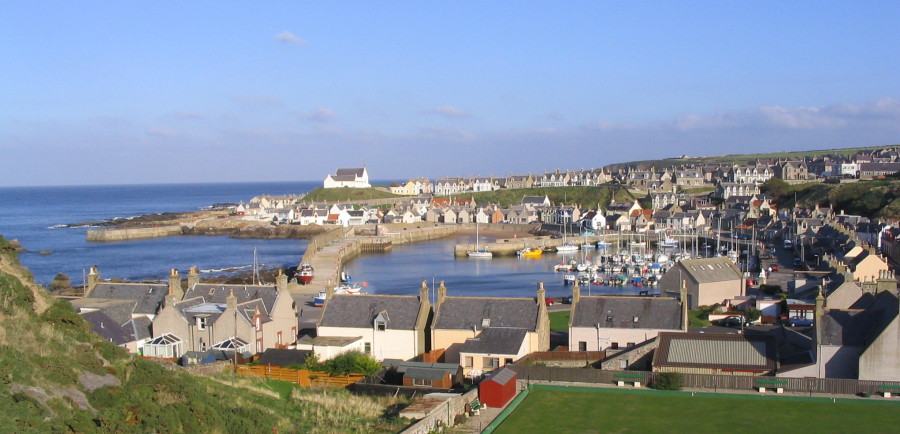
I’ve just had the privilege of spending the past week in the Moray fishing village of Findochty (somewhat strangely pronounced ‘Finnechty’). Together with the neighbouring village of Portknockie, this is a special place our family enjoys spending time in - not least because we’re convinced that Linda’s Fish Bar in nearby Cullen has the best fish and chips in the North East of Scotland! Laura, Elspeth, Joel, Esther and Sasha were with me for the weekend (and we did have fish and chips), and then I stayed on for five days of solitude and study.
It’s special quality for me is heightened by an event in 1859 that transformed the life of what was then a practically godless fishing village of less than 500 people, deeply immersed in the folklore and superstitions of the fisherfolk. Clues to this event remain in two active Brethren Assemblies, a Methodist Church, a Salvation Army hall as well as the prominent Church of Scotland in what even today is a village with a population of just 1106.
153 years ago, this village was one of those deeply touched by the North East Revival, which had begun in a children’s prayer meeting in Aberdeen. That winter, with the fishermen confined to shore, over a few short weeks and months, except for a handful of people, every member of the fishing community that made up the village, was said to have come to living faith in Jesus Christ.
 This no thoughtful, ordered, and organised event, but a tumultuous and breathtakingly chaotic time of ecstatic utterances, miraculous happenings, all night informal gatherings in homes and the local school for prayer and preaching, leading to dramatic conversions of even the most seemingly hard-bitten reprobates, though it was largely disapproved of and viewed with great suspicion for the most part by the official churches and clergy.
Nevertheless, God at work powerfully in the life of the community as a whole. For many, many decades, perhaps even the best part of a century the life of this village and indeed large stretches of this Moray coastline was transformed by the events of those few weeks. Only over recent decades as the fishing community has broken down, have the memories and impact of those times really faded.
So as I have been spending this week reading, studying, praying and writing in the small Baptist Union of Scotland cottage at the harbour side; as well as walking, and running along the nearby coastline, I’ve a sense even yet, of being on holy ground. Thinking about this event reminds me how central community has been in the past to the great works of God in revival and mission, and why I feel it’s so important today for church to continue be at the forefront of gathering people in community. And there’s a little part of me that can’t help but wonder how I as a Pastor might respond to such holy disorder being unleashed in the community I’m part of!
Lift Up Your Eyes
 I look up to the mountains; does my strength come from mountains?
No, my strength comes from God, who made heaven, and earth, and mountains...
While walking the long stretch of the West Highland Way that runs across the open bleakness that is Rannoch Moor, my eyes were drawn to the mountains that border that vast place. Huge, brooding masses of rock standing sentry, dominating the landscape as they have for aeons.
I wandered with the words of Psalm 121, a personal favourite, turning them over in my mind. That God, who caused these mountains in all their awesome vastness, to be, was the source of strength, of life, for me; was in that wild landscape, overwhelming. I nearly gasped out loud with the thought of it - the God who made these mountains (who was behind the incredible geological forces that had shaped the world around me), the God who made the earth (who had, in ways my mind cannot grasp, brought this planet into being in time and space), the God who somehow stood behind and had ordered the infiniteness of the universe; this God, this great Creating, Sustaining God, gives me life, and strength, and purpose, and protection.
And though God’s fulness is far beyond the limits of my mind, I can look up to the mountains and be reminded that though God is bigger than my problems, bigger than my needs, bigger than anything I can see; God is also present with and personal to me. It is God the world-maker who won’t let me stumble, the sleepless God who is at my side to protect me, the ever present God who guards my life - when I leave home, and when I return home, now and always.
Subscribe to:
Posts (Atom)